How much does a small business website cost in 2026?
The honest answer: it depends on what kind of website you need.
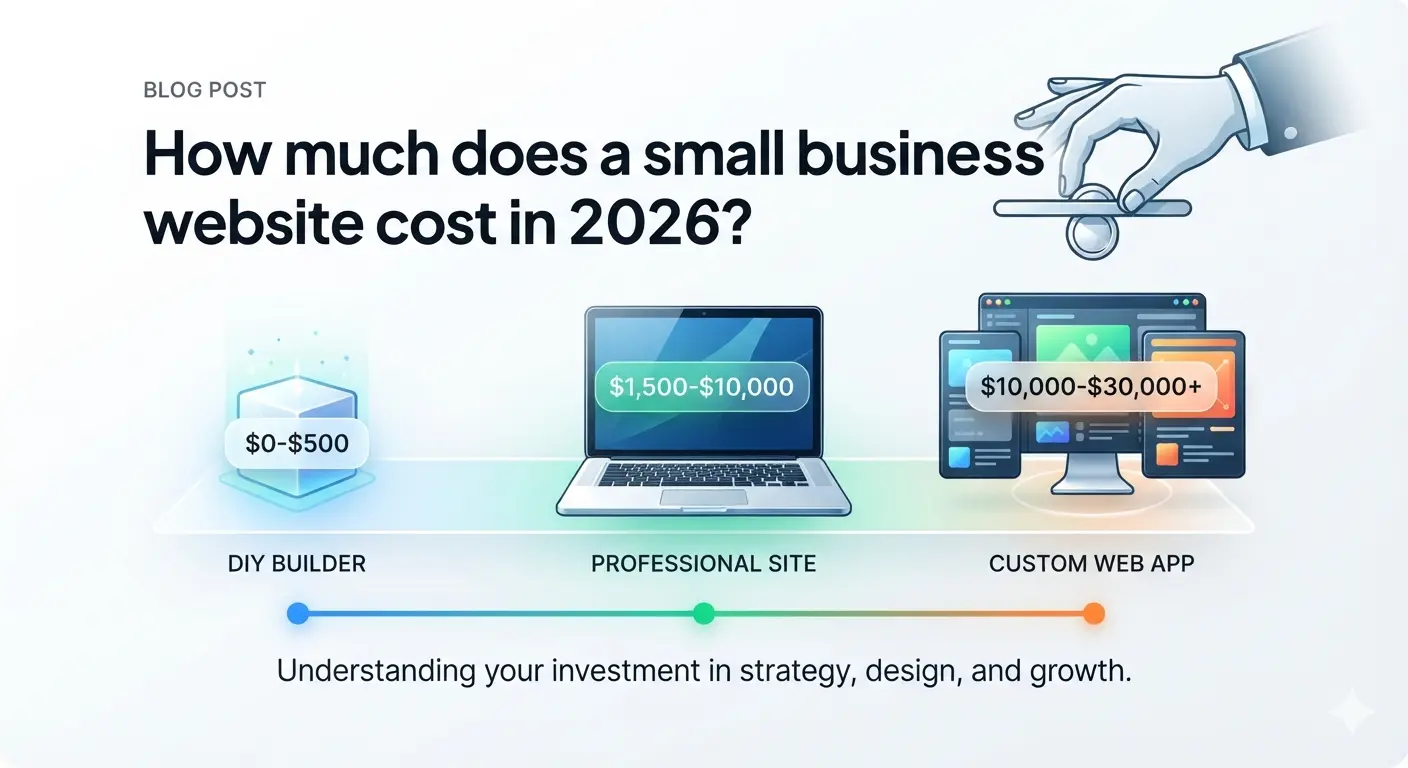
A simple DIY website can cost under $500 in the first year. A professional small business website usually costs $1,500 to $10,000. A custom website with ecommerce, booking, dashboards, automation, or advanced SEO can cost $10,000 to $30,000+.
That sounds like a huge range, but the range makes sense once you understand what you are actually buying: strategy, design, content, development, hosting, speed, security, SEO, support, and future growth.
This guide breaks down real website cost ranges, hidden expenses, pricing by website type, and how to choose the right budget without wasting money.
Quick answer: small business website cost in 2026
| Website type | Typical upfront cost | Monthly/annual cost | Best for |
|---|---|---|---|
| DIY website builder | $0-$500 | $15-$60/month | Very small sites, testing an idea |
| WordPress template website | $500-$2,500 | $100-$800/year | Budget-conscious businesses that want control |
| Freelancer-built website | $1,500-$6,000 | $300-$1,500/year | Professional local business sites |
| Small agency website | $3,000-$12,000 | $500-$3,000/year | Serious businesses that need strategy and support |
| Custom website or web app | $10,000-$30,000+ | $1,000-$10,000+/year | Ecommerce, SaaS, portals, booking systems, custom workflows |
For most small businesses, the smart budget is usually $2,000-$8,000 for the first build, plus $50-$300/month for hosting, maintenance, updates, and support.
If the website is only an online brochure, you can spend less. If the website is expected to generate leads, sell products, manage customers, or support daily operations, you should treat it as a business investment.
Why website prices vary so much
Two businesses can both say, “I need a website,” but mean completely different things.
One business may need:
- 5 pages
- Contact form
- Mobile responsive design
- Basic SEO
- Google Analytics
Another business may need:
- 30+ pages
- Online payment
- Booking system
- Blog platform
- Custom design
- SEO strategy
- Copywriting
- CRM integration
- Speed optimization
- Ongoing support
Those are not the same project.
Website pricing depends on scope, quality, business goals, platform, timeline, and who builds it.
The biggest cost factors
The price changes based on:
- Number of pages - a 5-page site costs less than a 50-page site
- Design quality - template design is cheaper than custom design
- Content writing - professional copywriting adds cost but improves conversions
- SEO setup - keyword research, metadata, technical SEO, and content structure require time
- Functionality - ecommerce, booking, membership, login, dashboards, or automation increase cost
- Platform - Wix, WordPress, Shopify, Astro, Next.js, and custom apps have different costs
- Maintenance - updates, backups, fixes, security, and support are ongoing
- Business value - a website expected to bring leads needs more strategy than a basic online profile
Cheap websites usually reduce scope, strategy, testing, support, or customization.
That does not always mean cheap is bad. It means you should understand the trade-off before you choose.
Website cost by build option
Option 1: DIY website builder
Typical cost: $0-$500 upfront, then $15-$60/month
DIY website builders include platforms like Wix, Squarespace, GoDaddy Website Builder, and similar tools.
They are popular because they are fast, beginner-friendly, and include hosting.
What you usually get
- Drag-and-drop builder
- Pre-made templates
- Hosting included
- Basic SEO settings
- Contact forms
- Simple blog or store features
- Customer support from the platform
Best for
- New businesses testing an idea
- Personal brands
- Simple portfolio sites
- Businesses with very limited budgets
- Owners who are comfortable doing the setup themselves
Pros
- Lowest upfront cost
- Fast launch
- No coding needed
- Hosting included
- Easy to edit yourself
Cons
- Limited customization
- Can look like a template
- Harder to migrate later
- SEO control may be limited
- You still need to write content and organize pages
- Monthly fees continue as long as the site is live
Realistic first-year budget
| Item | Estimated cost |
|---|---|
| Platform subscription | $180-$720/year |
| Domain | $10-$25/year |
| Premium template or apps | $0-$300/year |
| Your time | 10-50 hours |
| Total first year | $200-$1,000 |
DIY is not “free” if your time matters. If you spend 40 hours building the site and the result still does not bring leads, the hidden cost is business opportunity.
Option 2: WordPress template website
Typical cost: $500-$2,500 upfront, then $100-$800/year
WordPress is a strong option for small businesses because it gives more control than most website builders while staying affordable.
You can use a pre-made theme, customize it, and add plugins for SEO, forms, security, caching, analytics, and ecommerce.
What you usually get
- WordPress installation
- Theme setup
- Homepage and core pages
- Contact form
- Basic SEO plugin setup
- Security and backup plugins
- Mobile responsive layout
- Blog capability
Best for
- Small businesses that want to publish content
- Local service providers
- Consultants and agencies
- Businesses that care about SEO
- Owners who want control over their website
Pros
- Good SEO flexibility
- Large plugin ecosystem
- Easy to add a blog
- Scalable for many business types
- Lower platform lock-in than most builders
Cons
- Requires maintenance
- Plugins can conflict
- Poor hosting can make it slow
- Cheap themes may be bloated
- Security depends on updates and setup quality
Realistic first-year budget
| Item | Estimated cost |
|---|---|
| Hosting | $60-$600/year |
| Domain | $10-$25/year |
| Premium theme | $0-$100 |
| Plugins | $0-$500/year |
| Setup/customization | $500-$2,500 |
| Total first year | $700-$3,500 |
WordPress is often the best middle ground for a small business that wants SEO, content marketing, and future flexibility.
Option 3: Freelancer-built website
Typical cost: $1,500-$6,000 upfront, then $300-$1,500/year
A freelancer can build a more polished site than most business owners can create alone.
Freelancer pricing depends heavily on skill, location, portfolio quality, platform, communication, and whether they include strategy or only development.
What you usually get
- Customization of a theme or design
- 5-10 core pages
- Mobile responsive build
- Contact form
- Basic technical SEO
- Analytics setup
- Launch support
- Light training
Best for
- Local businesses
- Coaches and consultants
- Small agencies
- Clinics and service providers
- Businesses that need a professional site but not a large agency process
Pros
- More affordable than an agency
- More custom than DIY
- Direct communication with the person building the site
- Good balance of quality and cost when you hire well
Cons
- Quality varies widely
- Some freelancers disappear after launch
- Strategy may be limited
- Documentation may be weak
- Ongoing support may not be included
Realistic first-year budget
| Item | Estimated cost |
|---|---|
| Website build | $1,500-$6,000 |
| Hosting and domain | $100-$600/year |
| Maintenance | $300-$1,500/year |
| Content/copywriting | $0-$2,000 |
| Total first year | $2,000-$10,000 |
If you hire a freelancer, ask what happens after launch. A good website still needs updates, backups, monitoring, and occasional improvements.
Option 4: Small agency website
Typical cost: $3,000-$12,000 upfront, then $500-$3,000/year
An agency costs more because you are paying for a more complete process: discovery, strategy, design, development, SEO setup, quality assurance, and support.
This is often the best option when the website must bring leads, build trust, support sales, or represent an established business.
What you usually get
- Discovery and planning
- Sitemap and page structure
- Custom design direction
- Professional development
- Mobile responsive testing
- On-page SEO setup
- Speed optimization
- Contact forms and tracking
- Google Analytics and Search Console setup
- Launch support
- Maintenance options
Best for
- Established small businesses
- Service businesses that depend on leads
- Local businesses competing on Google
- Ecommerce brands
- Clinics, schools, agencies, and professional firms
- Businesses that want strategy, not just design
Pros
- Stronger strategy
- Better design quality
- Better SEO foundation
- More reliable process
- Ongoing support
- More business-focused recommendations
Cons
- Higher upfront cost
- Longer timeline
- Requires feedback and collaboration
- Not all agencies are equally skilled
Realistic first-year budget
| Item | Estimated cost |
|---|---|
| Website build | $3,000-$12,000 |
| Hosting and tools | $200-$1,500/year |
| Maintenance | $500-$3,000/year |
| Copywriting or content | $500-$4,000 |
| Total first year | $4,000-$20,000 |
For many serious small businesses, this is the most practical investment level. It gives you a site that looks professional, loads fast, supports SEO, and is built around business goals.
Option 5: Custom website or web application
Typical cost: $10,000-$30,000+ upfront, then $1,000-$10,000+/year
Custom websites are for businesses that need more than pages and forms.
This includes ecommerce platforms, booking systems, dashboards, portals, directories, membership websites, school systems, clinic software, and custom business tools.
What you usually get
- Custom UX planning
- Custom UI design
- Frontend development
- Backend development
- Database design
- User accounts or admin dashboard
- API integrations
- Payment gateway integration
- Testing and deployment
- Security review
- Ongoing support
Best for
- Ecommerce businesses
- Schools and education platforms
- Healthcare and clinic systems
- SaaS products
- Marketplaces
- Businesses with unique workflows
- Companies replacing manual operations with software
Pros
- Built around your exact business process
- More scalable
- No forced template limitations
- Better control over performance and features
- Can become a sellable digital product
Cons
- Higher cost
- Longer timeline
- Requires planning
- Needs ongoing maintenance
- More technical decisions
Realistic first-year budget
| Item | Estimated cost |
|---|---|
| Custom design and development | $10,000-$30,000+ |
| Hosting and infrastructure | $500-$5,000/year |
| Maintenance and support | $1,000-$10,000+/year |
| Integrations and tools | $500-$5,000/year |
| Total first year | $12,000-$50,000+ |
Custom development makes sense when the website is not just marketing, but part of how the business operates.
Website cost by business type
Local service business website
Examples: plumber, electrician, salon, consultant, lawyer, accountant, cleaning service.
Typical cost: $1,500-$8,000
Usually includes:
- Homepage
- About page
- Services page
- Service detail pages
- Contact page
- Testimonials
- Google Maps
- Click-to-call button
- Basic local SEO
This type of website should focus on trust, clear services, local keywords, reviews, and lead generation.
Professional business website
Examples: agency, clinic, coaching business, finance consultant, B2B service provider.
Typical cost: $3,000-$12,000
Usually includes:
- Brand-focused design
- Strong homepage messaging
- Case studies or portfolio
- Service pages
- Blog or resource section
- Lead capture forms
- SEO setup
- Analytics and conversion tracking
This type of website should communicate expertise and convert visitors into qualified inquiries.
Ecommerce website
Examples: online store, product brand, retail shop, digital product seller.
Typical cost: $3,000-$25,000+
Usually includes:
- Product catalog
- Product pages
- Cart and checkout
- Payment gateway
- Shipping setup
- Tax settings
- Inventory management
- Email notifications
- Ecommerce SEO
- Conversion optimization
Ecommerce websites cost more because every detail affects revenue: product images, checkout speed, trust, payment options, and mobile experience.
School or education website
Examples: school website, coaching center, training institute, online course platform.
Typical cost: $2,500-$20,000+
Usually includes:
- Admission information
- Notice board
- Teacher/student sections
- Results or attendance system
- Parent portal
- Course pages
- Online forms
- Admin dashboard
If the site only displays information, the cost stays lower. If it manages school operations, it becomes a software project.
Clinic or healthcare website
Examples: doctor website, clinic website, dental practice, telemedicine service.
Typical cost: $2,500-$20,000+
Usually includes:
- Doctor profile
- Services
- Appointment booking
- Patient information
- Contact and location
- Reviews
- Blog or health articles
- Optional patient management or prescription software
Healthcare websites need extra attention to trust, clarity, privacy, speed, and mobile experience.
What should be included in a professional website package?
Before you compare quotes, make sure each package includes the same things.
Strategy and planning
A professional website should start with:
- Business goals
- Target audience
- Competitor review
- Sitemap
- Page structure
- Content plan
- Conversion goals
Without strategy, the site may look nice but fail to generate results.
Design
Design should include:
- Homepage layout
- Inner page layout
- Mobile responsive design
- Brand colors and typography
- Clear navigation
- CTA placement
- Trust sections
Good design guides visitors toward action.
Development
Development should include:
- Clean, responsive build
- Fast loading pages
- Contact form
- Blog or CMS if needed
- Basic security
- Browser testing
- Mobile testing
SEO setup
At minimum, your website should include:
- SEO-friendly URLs
- Page titles
- Meta descriptions
- Heading structure
- Image alt text
- Internal links
- Sitemap
- Google Search Console setup
SEO is easier when it is planned before launch, not patched later.
Analytics and tracking
You should be able to measure:
- Website visitors
- Traffic sources
- Contact form submissions
- Calls or booking clicks
- Top pages
- Search performance
Basic analytics should be included in any professional business website.
Launch and support
Launch support should include:
- Domain connection
- Hosting setup
- SSL certificate
- Final testing
- Backup
- Basic training
- Post-launch support window
Ask if support is included for 7 days, 30 days, or longer.
Hidden website costs most business owners forget
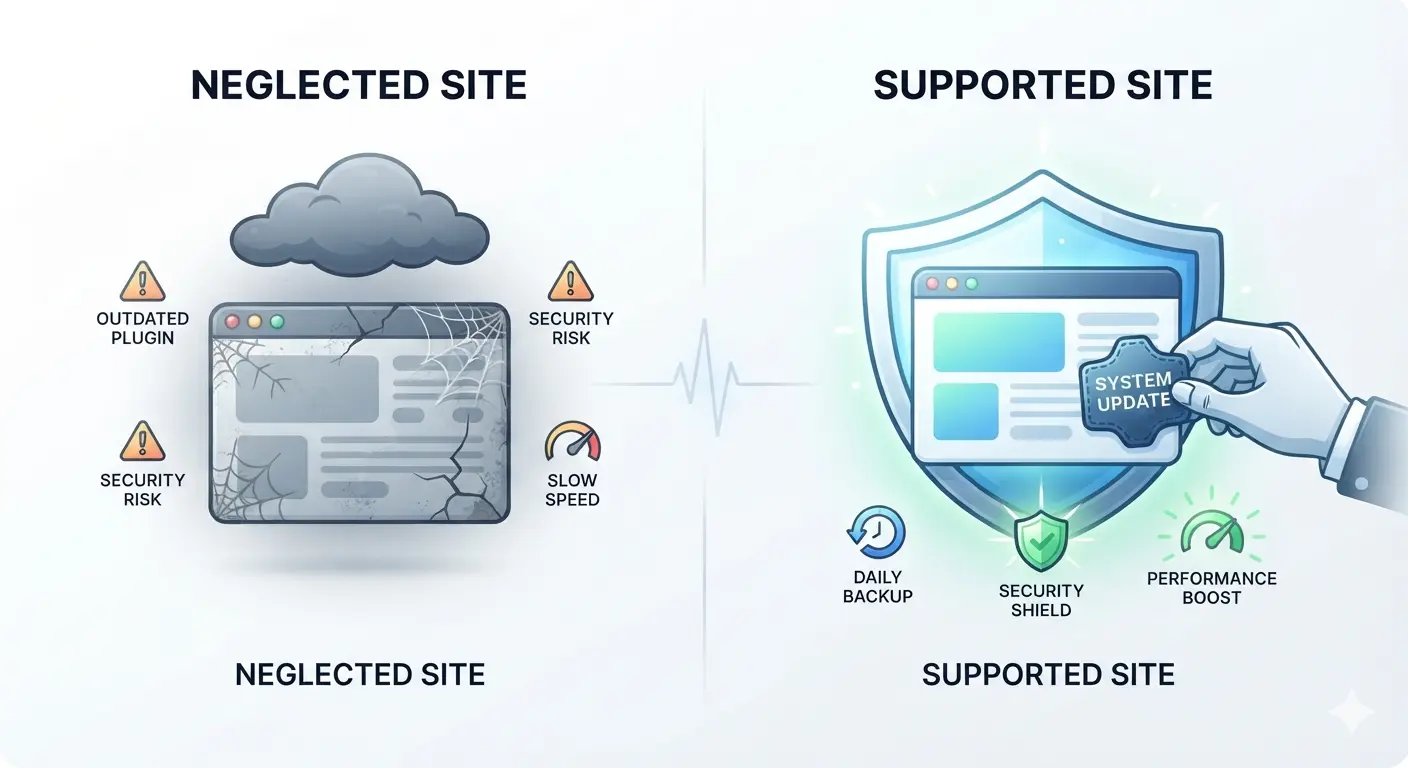
The build price is not the full price.
Here are the costs that often appear later.
Domain name
Typical cost: $10-$25/year
Your domain is your website address. Premium domains can cost more, but most businesses only need a simple brand domain.
Hosting
Typical cost: $60-$600/year for small sites, more for high-traffic or custom apps.
Hosting affects speed, security, uptime, and SEO.
SSL certificate
Typical cost: Free-$100/year
Most modern hosts include free SSL. If someone charges extra, ask why.
Premium plugins or apps
Typical cost: $0-$1,000/year
Forms, SEO tools, booking tools, page builders, security, ecommerce features, and automation apps may have recurring fees.
Copywriting
Typical cost: $300-$5,000+
Many website quotes do not include professional writing.
This matters because design cannot fix weak messaging. Your website needs clear copy that explains what you do, who you help, why you are trusted, and what visitors should do next.
Photography and graphics
Typical cost: $0-$2,000+
Real photos usually perform better than generic stock images. Product photos, team photos, office photos, and screenshots can improve trust.
SEO content
Typical cost: $100-$500+ per article depending on depth and quality.
If you want organic traffic, budget for ongoing content. A website without content has fewer chances to rank.
Maintenance
Typical cost: $50-$300/month
Maintenance may include:
- Software updates
- Backups
- Security monitoring
- Speed checks
- Bug fixes
- Content edits
- Technical support
Skipping maintenance can turn a cheap site into an expensive problem.
The real cost: website price vs website value
The cheapest website is not always the best deal.
Ask this question:
What does one new customer mean to your business?
If one customer is worth $100, a $5,000 website needs 50 customers to pay for itself.
If one customer is worth $2,000, the same website needs only 3 customers to become profitable.
Simple ROI example
Imagine a local service business invests $4,000 in a professional website.
After launch, the site brings:
- 20 inquiries per month
- 5 new customers per month
- $500 average customer value
That is $2,500/month in new revenue.
The website pays for itself in less than 2 months.
This is why website cost should be judged against business goals, not only the invoice.
How much should you spend?
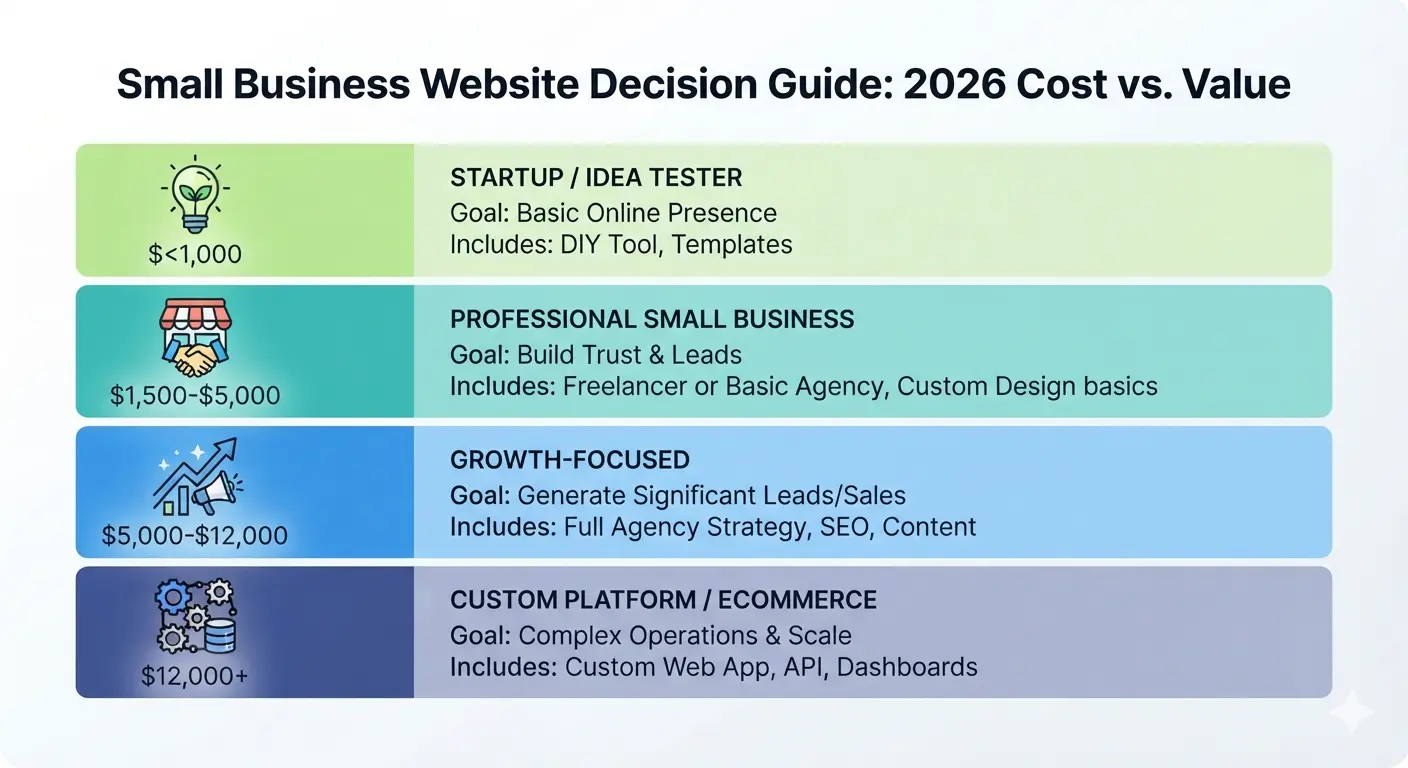
Use this simple decision guide.
Spend under $1,000 if:
- You are testing a new idea
- You only need a basic online presence
- You can write the content yourself
- You are comfortable using a DIY tool
- The website is not your main lead source yet
Spend $1,500-$5,000 if:
- You need a professional small business website
- You want better design than DIY
- You need contact forms and local SEO basics
- You want someone else to handle setup
- Your business depends on trust and credibility
Spend $5,000-$12,000 if:
- Your website should generate leads
- You need custom design and strategy
- You want strong SEO foundations
- You need multiple service pages
- You want reliable support after launch
- You are competing seriously in your local market
Spend $12,000+ if:
- You need ecommerce
- You need a customer portal
- You need booking, payment, or automation
- You need custom dashboards
- Your website is part of business operations
- You are building a digital product or software platform
Cheap website vs professional website
Here is the difference in practical terms.
| Area | Cheap website | Professional website |
|---|---|---|
| Strategy | Little or none | Built around business goals |
| Design | Template-based | Brand-focused and conversion-focused |
| Content | Owner writes everything | Guided or professionally written |
| SEO | Basic settings only | Planned page structure and optimization |
| Speed | Depends on template/platform | Tested and optimized |
| Support | Limited | Clear post-launch support |
| Growth | May need rebuilding later | Built to expand |
A cheap website can be fine for the beginning.
But if your website is meant to bring leads, build authority, or sell products, professional planning usually saves money long term.
Website pricing checklist before hiring anyone
Before you pay a designer, freelancer, or agency, ask these questions:
- What pages are included?
- Is copywriting included?
- Is SEO setup included?
- Is hosting included?
- Who owns the website after launch?
- Can I edit the content myself?
- Is mobile testing included?
- Is speed optimization included?
- Is Google Analytics installed?
- Is Google Search Console set up?
- Is there a backup system?
- Is security included?
- How many revisions are included?
- What happens after launch?
- What does maintenance cost?
If a quote is much cheaper than others, compare the included work carefully.
Often the cheapest quote simply excludes important parts.
Example website budgets
Budget 1: Starter business website
Estimated cost: $800-$2,000
Good for:
- New local business
- Simple portfolio
- Basic online presence
Includes:
- 3-5 pages
- Template design
- Contact form
- Basic mobile layout
- Basic SEO settings
Limitations:
- Less unique design
- Limited SEO strategy
- Minimal content support
Budget 2: Professional lead generation website
Estimated cost: $3,000-$8,000
Good for:
- Local service businesses
- Agencies
- Consultants
- Clinics
- Schools
Includes:
- Custom homepage structure
- 5-12 pages
- Service pages
- Conversion-focused copy guidance
- Local SEO basics
- Analytics
- Speed optimization
- Launch support
This is the best fit for many established small businesses.
Budget 3: Growth-focused website
Estimated cost: $8,000-$15,000
Good for:
- Businesses investing in SEO
- Brands with multiple services
- Ecommerce starters
- Businesses that need stronger content and conversion
Includes:
- Custom design system
- Advanced page structure
- Multiple service/location pages
- Blog setup
- Conversion tracking
- Technical SEO
- Deeper content planning
- Ongoing support
Budget 4: Custom digital platform
Estimated cost: $15,000-$50,000+
Good for:
- Ecommerce platforms
- School management systems
- Clinic software
- Booking platforms
- SaaS products
- Business dashboards
Includes:
- Custom design
- Custom development
- Admin dashboard
- Database
- User roles
- Payment or API integrations
- Security and testing
- Ongoing development support
How to reduce website cost without hurting quality
You can lower the cost if you prepare well.
1. Write your content before design starts
Prepare:
- About text
- Service descriptions
- Contact details
- Testimonials
- FAQs
- Photos
- Logo and brand assets
Clear content reduces revision time.
2. Start with essential pages
You do not need 30 pages on day one.
Start with:
- Homepage
- About
- Services
- Contact
- Blog or resources
Then add service detail pages and SEO content over time.
3. Use a proven platform
Do not build custom software when WordPress, Shopify, or a simple static site can solve the problem.
Custom development is powerful, but only when the business case is clear.
4. Avoid unnecessary features
Features that sound nice can increase cost:
- Complex animations
- Custom calculators
- Membership systems
- Multi-step forms
- Live chat
- Advanced filters
- Custom dashboards
Add them only if they support a real business goal.
5. Plan SEO early
SEO is cheaper when it is built into the site structure from the start.
Adding SEO after launch often means rewriting pages, changing URLs, and rebuilding content structure.
Common website cost mistakes
Mistake 1: Choosing the cheapest quote
Low price is attractive, but it may exclude strategy, SEO, copywriting, support, speed, or maintenance.
Compare scope, not just price.
Mistake 2: Not budgeting for maintenance
Websites need care.
Without maintenance, your site can become slow, outdated, insecure, or broken.
Mistake 3: Ignoring content
Many owners spend on design but write weak content.
Your content sells the service. Design supports the message.
Mistake 4: Building without SEO
A beautiful website that no one finds will not bring organic traffic.
Plan keywords, page structure, titles, descriptions, headings, and internal links before launch.
Mistake 5: Treating the website as a one-time project
A good website improves over time.
You should update pages, publish helpful blog posts, review analytics, improve conversion rates, and refresh offers.
Website cost FAQ
What is the average cost of a small business website in 2026?
Most small business websites cost between $1,500 and $10,000 depending on design quality, number of pages, SEO, content, and features.
A simple DIY website may cost under $1,000 in the first year. A professional lead generation site usually costs $3,000-$8,000. Custom ecommerce or software projects can cost $10,000-$30,000+.
Can I build a website for free?
Yes, some platforms offer free plans. But free websites usually include platform branding, limited features, limited domain options, and less professional credibility.
Free is fine for testing. For a real business, use a custom domain and a paid plan.
How much does a 5-page website cost?
A 5-page website usually costs:
- DIY: $200-$1,000 first year
- Freelancer: $1,500-$4,000
- Agency: $3,000-$8,000
The price depends on whether copywriting, SEO, custom design, hosting, and maintenance are included.
How much does an ecommerce website cost?
Small ecommerce websites usually cost $3,000-$15,000. More complex ecommerce sites can cost $15,000-$50,000+.
Costs increase with product count, payment setup, shipping rules, custom checkout, inventory management, subscriptions, and integrations.
Should I choose WordPress, Wix, Shopify, or a custom website?
Choose based on your goal:
- Wix or Squarespace for simple DIY websites
- WordPress for SEO-focused business websites and blogs
- Shopify for ecommerce
- Custom development for unique business workflows, portals, dashboards, or software products
Is SEO included in website design cost?
Sometimes.
Basic SEO setup may be included, but full SEO strategy, keyword research, content writing, local SEO, and ongoing optimization usually cost extra.
Always ask what “SEO included” actually means.
How long does it take to build a small business website?
Typical timelines:
- DIY website: 1-14 days
- Freelancer website: 2-6 weeks
- Agency website: 4-12 weeks
- Custom web application: 8-24+ weeks
Content delays are one of the biggest reasons websites take longer than expected.
Do I need monthly website maintenance?
Yes, if your website runs on WordPress, ecommerce, plugins, forms, or custom code.
Maintenance keeps your website secure, backed up, updated, and working properly.
Final recommendation
If you are a new business with a tiny budget, start simple with a DIY builder or WordPress template.
If your business already has customers and your website needs to generate leads, plan for a professional budget of $3,000-$8,000.
If you need ecommerce, booking, dashboards, portals, or custom workflows, expect a larger custom development budget.
The best website is not the cheapest one. It is the one that matches your business stage, supports your goals, and helps visitors become customers.
Need help estimating your website budget? Contact TheWebPal for a free consultation, website planning session, or design package recommendation based on your business goals.